

AI Keeps Exposing the Same Five Problems. It Is Time to Name Them.
Everyone is talking about tools, models, integrations, and ROI. Very few people are talking about what keeps getting in the way.

Very few people are talking about what keeps getting in the way.
Something has been bothering me about the AI conversation.
Everyone is talking about tools, models, integrations, and ROI. Very few people are talking about what keeps getting in the way. And yet across every serious AI conversation happening right now, the same five conditions keep appearing. Not capability gaps. Not technology failures. Structural conditions that existed long before AI arrived and that AI is now making impossible to ignore.
I have seen these patterns across engagements at GoodMora, across the conversations I am having with leaders in financial services, FMCG, consulting, and brand strategy. They are consistent. They are predictable. And until organisations name them directly, AI investment will continue to produce the same disappointing results.
Here are the five.
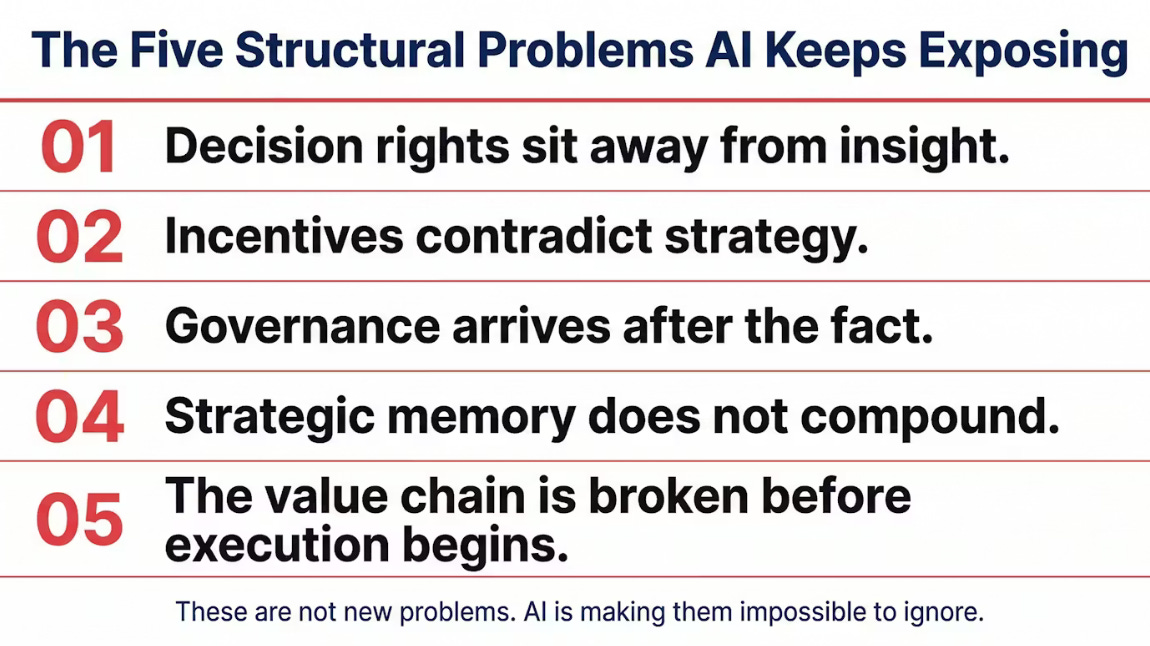
One. Decision rights sit away from insight.
AI produces signals faster than most governance structures can process them. The person who sees the signal cannot act on it. The person who can act does not trust it or does not see it in time. So the insight exists, and nothing changes.
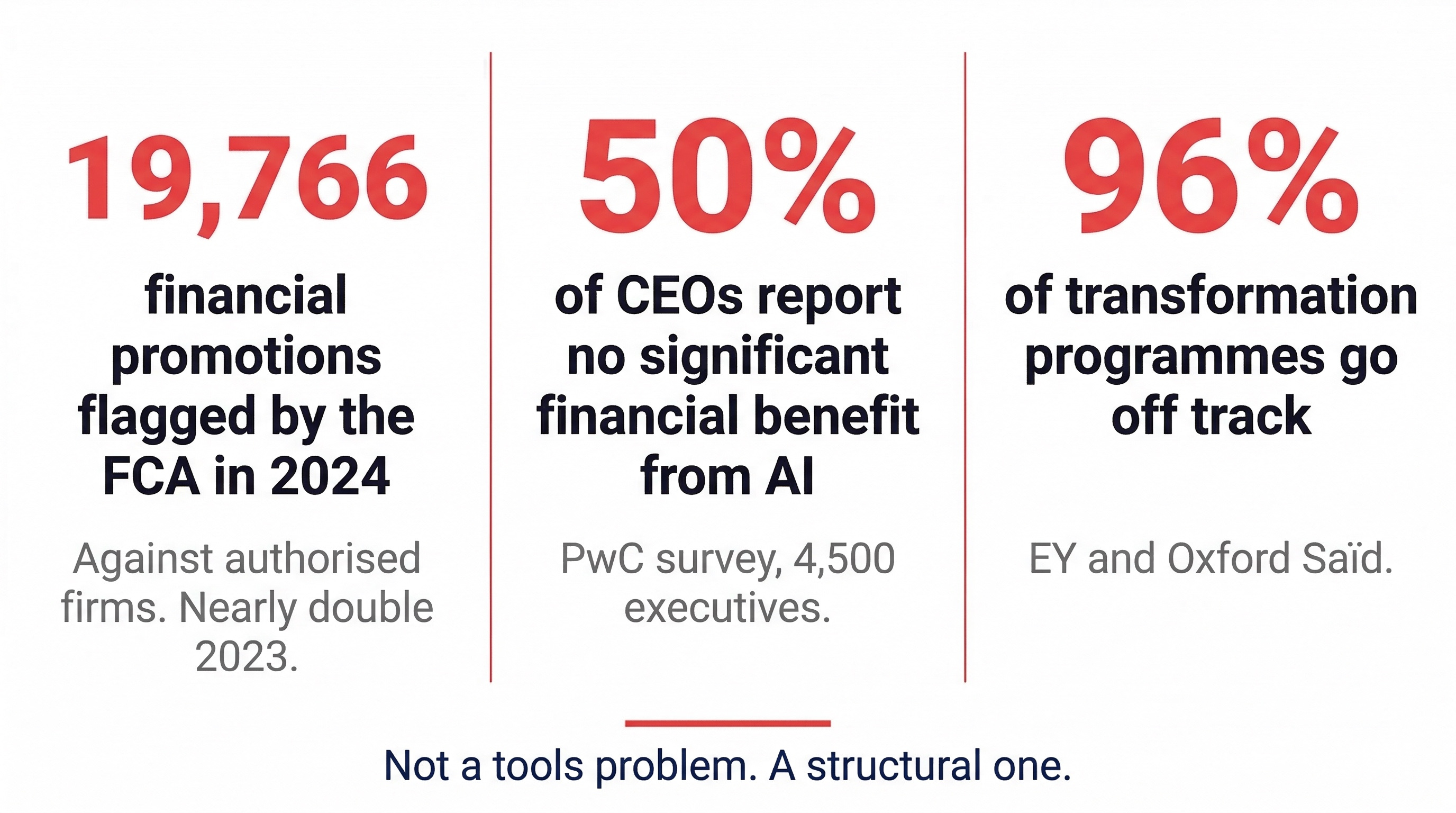
The FCA intervened in 19,766 financial promotions in 2024. Nearly double the prior year. Against authorised firms with compliance teams trying to do the right thing. The tools were not the problem. The structure between insight and action was. When governance runs at meeting spee,d and AI runs at machine speed, the gap between them is where compliance risk lives.
Two. Incentives contradict strategy.
This is the most common and most expensive structural failure. Leadership approves an AI strategy. The teams responsible for execution are still measured on what the old model rewarded. AI accelerates output against the wrong objective.
More than half of nearly 4,500 CEOs polled by PwC said they have seen no significant financial benefit from AI so far. That is not a tool’s problem. Tools are working. The incentive structures are absorbing the gain before it reaches the bottom line. When the reward system does not change, behaviour does not change. AI just makes the misalignment more productive.
Three. Governance arrives after the fact.
Compliance, oversight, and accountability were designed as checkpoints at the end of workflows built for a slower world. That design assumption is no longer safe.
When every customer interaction is continuously indexed into personal AI memory, the gap between what a brand promises and what it operationally delivers becomes unmanageable after the fact. You cannot retroactively patch governance into a system that has already been captured. The brands that will navigate the ambient intelligence era are not the ones with the best response protocols. They are the ones where promise and operational reality are structurally aligned before the machine starts taking notes.
Four. Strategic memory does not compound.
Organisations commission new work rather than synthesising what they already know. Every engagement starts from scratch. Every new team leader wants a new piece of research. Every AI deployment begins with a blank canvas rather than building on the structural understanding that already exists.
This is one of the most avoidable forms of waste in modern organisations. AI makes synthesis cheap and fast. The constraint is no longer the ability to aggregate what is known. It is the structural habit of not doing it. Organisations that build a compounding structural memory, where every engagement, every diagnostic, every simulation adds to a shared understanding of how the business actually works, will make decisions faster and with more confidence than those starting from zero each time.
This is central to what GoodMora builds. The Business Genome is not a one-time diagnostic. It is a living structural model that gets sharper with every engagement. The Archive layer exists precisely because strategic memory should compound, not reset.
Five. The value chain is broken before execution begins.
FMCG brands cannot answer a basic question: are our products actually on the shelf right now? The distributor report shows what was shipped. The POS data shows what was sold. Neither shows what is happening at the point of sale at this moment. Revenue disappears in that gap. Not because of bad strategy or poor execution intent. Because the structural connection between the operating reality and the decision-making layer was never wired.
This is not unique to FMCG. Ninety-six percent of transformation programmes reach a point where they go off track, per EY and Oxford Said. In most cases, the value chain was broken before the programme began. The strategy was approved without a structural view of whether the organisation could actually deliver it. Two-thirds of organisations surveyed by McKinsey have not started scaling AI across the enterprise. The technology is not the bottleneck. The structural readiness to absorb it is.
What GoodMora does with this
Each of these five problems has a common root. The organisation does not have a shared, testable, machine-readable model of how it actually works. Not how it is supposed to work. The real system. Decisions, incentives, information flows, accountability loops, and the places where strategy quietly dies before execution begins.
GoodMora builds that model. We call it the Business Genome. It is not a consulting framework. It is structural intelligence. A computable representation of the organisation that makes the five conditions above visible, testable, and fixable before capital is committed.
Builder maps the organisation from real inputs, turning scattered documents, operating logic, and decision flows into a coherent structural model in weeks, not months.
Archive benchmarks that structure against comparable organisations and known patterns. This is where strategic memory starts to compound. You stop starting from scratch.
The browser lets leaders explore options and simulate changes before they commit. What happens to the rest of the organisation if we change this? Where does risk concentrate? What breaks first? What compounds?
The result is not a report. It is a decision-grade structural model that makes transformation visible, measurable, and testable before anyone spends a dime.
The question every leadership team should be asking
Before your next AI programme. Before your next transformation approval. Before your next integration engagement.
Does your organisation have a clear, shared, testable view of how it actually works?
Not the org chart. Not the strategy deck. The real system.
If the answer is unclear, everything that follows is more expensive than it needs to be. The five problems above will keep appearing. AI will keep exposing them. And the gap between investment and return will persist.
That is the gap GoodMora exists to close.
As always, thank you for reading,
Gary B
Sources
FCA Financial Promotions Data 2024. Published February 2025. fca.org.uk/data/financial-promotions-data-2024. The FCA recorded 19,766 interventions against authorised firms in 2024, up from 10,008 in 2023, a 97.5 percent increase in a single year.
PricewaterhouseCoopers. CEO Survey, late 2025. Nearly 4,500 chief executives were surveyed. More than half reported no significant financial benefit from AI investments to date. Referenced in The Wall Street Journal, “AI Needs Management Consultants After All,” Allison Pohle, March 8, 2026.
McKinsey and Company. Employee survey, summer 2025. Approximately 2,000 employees were surveyed. About two-thirds said their organisations had not started scaling AI across the enterprise. Referenced in The Wall Street Journal, “AI Needs Management Consultants After All,” Allison Pohle, March 8, 2026.
EY and University of Oxford Said Business School. Research on transformation programme outcomes. 96 percent of programmes reach a turning point where they go off track. Referenced in GoodMora White Paper on Structural Intelligence, 2025.
Deloitte UK. Transformation research. 60 percent of transformation efforts fail to deliver intended results. Referenced in GoodMora White Paper on Structural Intelligence, 2025.
K2 Consulting Research. Global consulting industry data. Global consulting grew 5.5 percent in 2025, double the rate of the prior year. Referenced in The Wall Street Journal, “AI Needs Management Consultants After All,” Allison Pohle, March 8, 2026.
Unilever Annual Report 2024. Approximately 59 percent of the total turnover is generated from emerging markets. Referenced in Libera Global AI, “Why FMCG Brands Still Don’t Know What Is Happening on Their Shelves,” March 17, 2026.
FCA, Finalised Guidance FG24/1: Financial Promotions on Social Media, March 2024. Confirmed that financial promotions rules apply to all digital formats, including Instagram Stories, TikTok, Discord, Telegram, and Reddit. Referenced in Finspector, “The Complexity of Modern Financial Promotions,” March 17, 2026.
FCA, Wholesale Markets Regulatory Priorities Report, March 19, 2026. Sets out five regulatory priorities, including the safe and responsible adoption of new technology. Notes that 75 percent of UK financial services firms are already using some form of AI, with a further 10 percent planning to adopt it within three years. Source: Bank of England and FCA joint survey, referenced in Finspector, “The FCA’s New Wholesale Markets Priorities,” March 23, 2026.
The Wall Street Journal, “AI Needs Management Consultants After All,” Allison Pohle, March 8, 2026. Reports Accenture disclosed 2.2 billion dollars in new AI bookings in its most recent quarter. wsj.com/tech/ai/ai-needs-management-consultants-after-all-bd28ecb9